Many of our students at Shelton State Community College are enrolled in Criminal Justice courses in hopes of working with the Department of Public Safety. Career Services is focusing on the careers of Alabama State Troopers this week. As you know, this is an honorable career that can be risky but necessary in order for the great state of Alabama to continue to be a safe place to live.
The following information was found on the Alabama Department of Public Safety’s website. Go to http://dps.alabama.gov/Home/Default.aspx for more information.
• State Trooper – Not just a job…a great career choice.
• Job as a Trooper
• Is a Trooper’s Job Right for Me?
• Physical Fitness Entry Level Standards for Trooper Applicants
• What is State Trooper Training Like?
• State Trooper Pay Scale (As of September 2008)
• Alabama Peace Officers Standards and Training Commission
We also found the following article under the Newsletters section using the DISCOVER program. Many of you have an ID to this program and are able to explore other articles and access the many resources DISCOVER offers. If you would like more information regarding the career assessment program, DISCOVER, please call the Career Services Center (205.391.5874) for more information.
Highway Patrol Officer
________________________________________
Jim Smith has been a state patrol officer for five years. Men and women who do this work are sometimes called state troopers. Jim's particular job differs from that of a policeman in the city because he is expected to be familiar with and patrol an assigned area of the county. Working mostly alone, he provides a variety of services to the motorists who use the highways. Jim enjoys the challenges and responsibilities of his work, and has become well-known and a dependable friend to many people. As part of this occupation, he wears a uniform, carries firearms, drives a special car, and is trained to respond to many types of emergencies. In order to become a member of the state police force, Jim had to get his bachelor's degree and then be accepted into and successfully graduate from the Highway Patrol Academy.
State police officers are best known for issuing traffic citations to motorists who break the law. Jim knows this part of his job is very important because it encourages motorists to follow the rules. Reminding motorists of the laws and pointing out their mistakes prevents accidents. Jim is often called to accidents, where he may direct traffic, give first aid, and call for emergency equipment. He might take photographs to determine the cause of the accident, gather evidence in criminal cases, and write reports. He also appears in court as a witness when necessary.
Jim starts his day early. He is in the car and on the road by 6:00 a.m. Although his hours are part of a regular schedule, he is expected to be "on duty" 24 hours a day. Whenever he sees someone in trouble, he gives them help. His training has equipped him to work with minimal direct supervision, and his main responsibility is to ensure public safety on the state highways.
Today is a national holiday, and that means more cars than usual will be on the roads, and a greater probability exists that there will be drunk drivers and accidents. Jim will be on the lookout for those who are speeding, going to the scene of any accidents in his area, and possibly giving first aid to crash victims. By mid-morning, he has covered one crash involving bodily injury, called medical rescue technicians to take that person to the hospital, and answered a call from someone whose neighbor was threatening him with a gun. Later in the day, he will help with traffic direction at a large outdoor concert. Thousands of people will be arriving, and patrol officers will direct traffic flow towards the parking lots.
By the end of the holiday, Jim will have, perhaps, prevented loss of life and property destruction. His quick decision-making and good communication skills will have found help for people at accident scenes and stopped an argument from ending in a shooting. These are the results of his good training and dedication to his work.
There are other duties that highway patrol officers perform. They investigate crime scenes, pursue and arrest criminals, and inspect motor vehicles for compliance with weight and hazardous materials regulations. Officers are members of the community and often give presentations at schools and civic group meetings where they teach public safety. They also help with the training of new highway patrol recruits. Jim Smith is proud of his job as a highway patrol officer. He is in a special group of people who help protect the public from crime and keep the roads safe for travel.
Thursday, September 29, 2011
Tuesday, August 23, 2011
Making Contact with Employers
With classes starting back and students getting back into the swing of the start of a semester, many students are searching for part-time and full-time jobs. Career Services offers job searching assistance on Shelton State’s website. Students will find job search websites and information on the current labor market. Visit https://www.sheltonstate.edu/current_students/career_services_center.aspx for more information.
The following article was found through DISCOVER's website:
Making Contact with Employers
When you are hunting for a job, getting your foot in the door is difficult. How do you get the attention of the employer? How can you find out about job openings? How do you find out more about an organization than is provided on their web site?
Know What They Need and What You Can Offer
Rule #1: Identify the kind of job you want. Know how your skills, education, and/or experience "fit" the job for which you are applying. If you have particular strengths or weaknesses, be sure you think about how you will explain them to employers. Use the occupational description in DISCOVER to decide which skills will be useful and how you will use them in this kind of work. Then use the Internet to find job descriptions in your field. Look at other people's resumes to see how you can strengthen your resume. Visit the websites of companies that employ people in your field, or use a search engine to identify employers in your field.
Find-a-Friend
Rule #2: Find people who either do the kind of work you want to do, or know people who do the kind of work you want to do. Ask for their help. Good places to find such people are professional organizations in your field, such as the American Marketing Association or Teacher's Federation, or general professional associations like the Chamber of Commerce or Lion's Club. Attend meetings or subscribe to listservs to strike up conversations with "pros."
Other ways to network with people who can help you are college alumni associations, mentoring programs, and jobshadowing partners. Use directories, such as professional association guides, telephone books, and on-line directories to make contact with employers. Your local library can also provide helpful ideas.
Getting in the Door
Rule #3: The phone is your friend. We may live on the Information Superhighway, but business is still mostly done by phone. Use the phone to find out:
• Who you should bring or send your resume to
• What the current issues are within the company
• Who the people are who do the kind of work you'd like
• If there are job openings now or whether there may be openings soon
A good way to prepare for the phone call is to write a script. That way you'll have the right words in front of you when need them. When you contact a person by phone:
• Introduce yourself and briefly tell her or him where you went to school, when you graduated (if you have, of course), and why you are calling.
• Highlight your qualifications in a few sentences. Ask if you might stop by for a short visit. If not, offer to drop off your resume.
• Whether you get a chance to follow-up or not, be sure you ask the person if you can check back in a month or so.
• Be sure you are upbeat and thank the person when you hang up.
With these tips, you should be working in no time. Good luck!
The following article was found through DISCOVER's website:
Making Contact with Employers
When you are hunting for a job, getting your foot in the door is difficult. How do you get the attention of the employer? How can you find out about job openings? How do you find out more about an organization than is provided on their web site?
Know What They Need and What You Can Offer
Rule #1: Identify the kind of job you want. Know how your skills, education, and/or experience "fit" the job for which you are applying. If you have particular strengths or weaknesses, be sure you think about how you will explain them to employers. Use the occupational description in DISCOVER to decide which skills will be useful and how you will use them in this kind of work. Then use the Internet to find job descriptions in your field. Look at other people's resumes to see how you can strengthen your resume. Visit the websites of companies that employ people in your field, or use a search engine to identify employers in your field.
Find-a-Friend
Rule #2: Find people who either do the kind of work you want to do, or know people who do the kind of work you want to do. Ask for their help. Good places to find such people are professional organizations in your field, such as the American Marketing Association or Teacher's Federation, or general professional associations like the Chamber of Commerce or Lion's Club. Attend meetings or subscribe to listservs to strike up conversations with "pros."
Other ways to network with people who can help you are college alumni associations, mentoring programs, and jobshadowing partners. Use directories, such as professional association guides, telephone books, and on-line directories to make contact with employers. Your local library can also provide helpful ideas.
Getting in the Door
Rule #3: The phone is your friend. We may live on the Information Superhighway, but business is still mostly done by phone. Use the phone to find out:
• Who you should bring or send your resume to
• What the current issues are within the company
• Who the people are who do the kind of work you'd like
• If there are job openings now or whether there may be openings soon
A good way to prepare for the phone call is to write a script. That way you'll have the right words in front of you when need them. When you contact a person by phone:
• Introduce yourself and briefly tell her or him where you went to school, when you graduated (if you have, of course), and why you are calling.
• Highlight your qualifications in a few sentences. Ask if you might stop by for a short visit. If not, offer to drop off your resume.
• Whether you get a chance to follow-up or not, be sure you ask the person if you can check back in a month or so.
• Be sure you are upbeat and thank the person when you hang up.
With these tips, you should be working in no time. Good luck!
Friday, July 29, 2011
Many students are seeking fall employment
The Career Services Center has been hopping this week with students preparing for fall employment and seeking career guidance. One service the center offers is help with resume writing. If you would like for the CSC staff to take a look at your resume, give us a call at 205.391.5874 or 205.391.2204.
Also, you can get started writing your resume by using your DISCOVER account. This is an excellent tool in building a basic resume for you to elaborate on as you add skills to your repertoire. Career Services visits all orientation classes each semester to administer the DISCOVER assessment. If you do not have a log-in name and are interested in learning more about it, call the CSC to set up an appointment.
To help you get started, we have included a description of the 3 most common styles of resumes. The following article was found at www.careerperfect.com:
THE MOST EFFECTIVE RESUME FORMATS
Each individual possesses a unique set of talents, skills, abilities, experience, and training; as a result, one must consider all factors in order to determine the best strategy.
Although there are dozens of different formats, a resume will fit one of three basic categories: Chronological, Functional, and Combination.
1. 1. Chronological
A chronological format emphasizes professional experience; however, it is best if a chronological resume utilizes a focused summary of qualifications that quickly conveys essential skills to an employer. This provides an opportunity to immediately capture attention through vital keywords and employer-centric language, thereby ensuring you make a strong first impression during the critical 15-second initial human screening.
Without a summary of qualifications, the chronological format can be risky as it will simply stress the past rather than target your goals and the employer's needs. With potentially hundreds of resumes to review, the employer cannot be burdened with interpreting a candidate's work history during the few seconds of an initial screen. Rather, the summary of qualifications does the work, ensuring you get the attention you deserve...and that relevant skills won't be missed.
Generally, the chronological format works well if one's past employment meets certain criteria, including:
The work history directly relates to the targeted position; ideally the history will show progressive responsibility in a specific career direction.
The years of experience fall within a marketable range and include present (or very recent) employment.
When work history is not directly related to one's current employment objective, a Combination format is likely the best approach.
2. Functional
This largely obsolete format seeks to present qualifications that relate to the targeted position by focusing on skills and qualifications only; this is achieved by using functional headings that are strategically developed around one's transferable skills without developing details about the work history. If work history is presented, it is generally only as a simple list at the end of the resume.
The traditional functional format was historically used to hide unfavorable elements in a candidate's employment history, so it is often viewed with extreme caution by human resource and management professionals. In particular, they may wonder what the candidate is trying to hide, especially when the work history is omitted entirely (which we do not recommend).
While the functional format was once considered effective if a job seeker's current employment objectives were completely unrelated to his or her work history, recent advances in resume parsing (screening) technology make it impossible for a functional resume to survive in most online job boards or employer applicant tracking systems. Virtually the only time a functional resume may be effective is when the resume will be delivered directly to the hiring manager and there is no chance that a resume parsing system will be applied. Even then, it is best to avoid combining non-complementary skills (e.g., truck driving and office management) as doing so simply conveys a lack of focus.
In most cases where one is considering a Functional approach, a Combination/Hybrid format will prove to be more effective.
3. Combination/Hybrid
The combination format incorporates the functional treatment's strengths without posing the same risk; it, too, will demonstrate, at the beginning of the resume, a candidate’s key strengths, skills, and core competencies that are strategically developed around one's career goals and transferable skills (if applicable), thereby placing greater emphasis on one's overall skill set. Unlike the functional style, the combination resume includes details of the work history, including responsibilities, dates, contributions, and achievements. This makes the combination format superior, except in extremely rare circumstances, to the traditional functional format.
While in most instances the combination format is the best choice for the majority of job seekers—it quickly illustrates one’s core skills in the 15-second human scan—it also works best in resume parsing systems where recent work history lacks a direct correlation to current employment objectives (such as with new graduates or those changing careers). By demonstrating, through functional headings, relevant skills, education, training, and accomplishments, the connection between your transferable skills and the targeted position will be clear.
Reference: http://www.careerperfect.com/content/resume-writing-help-effective-resume-format/
Also, you can get started writing your resume by using your DISCOVER account. This is an excellent tool in building a basic resume for you to elaborate on as you add skills to your repertoire. Career Services visits all orientation classes each semester to administer the DISCOVER assessment. If you do not have a log-in name and are interested in learning more about it, call the CSC to set up an appointment.
To help you get started, we have included a description of the 3 most common styles of resumes. The following article was found at www.careerperfect.com:
THE MOST EFFECTIVE RESUME FORMATS
Each individual possesses a unique set of talents, skills, abilities, experience, and training; as a result, one must consider all factors in order to determine the best strategy.
Although there are dozens of different formats, a resume will fit one of three basic categories: Chronological, Functional, and Combination.
1. 1. Chronological
A chronological format emphasizes professional experience; however, it is best if a chronological resume utilizes a focused summary of qualifications that quickly conveys essential skills to an employer. This provides an opportunity to immediately capture attention through vital keywords and employer-centric language, thereby ensuring you make a strong first impression during the critical 15-second initial human screening.
Without a summary of qualifications, the chronological format can be risky as it will simply stress the past rather than target your goals and the employer's needs. With potentially hundreds of resumes to review, the employer cannot be burdened with interpreting a candidate's work history during the few seconds of an initial screen. Rather, the summary of qualifications does the work, ensuring you get the attention you deserve...and that relevant skills won't be missed.
Generally, the chronological format works well if one's past employment meets certain criteria, including:
The work history directly relates to the targeted position; ideally the history will show progressive responsibility in a specific career direction.
The years of experience fall within a marketable range and include present (or very recent) employment.
When work history is not directly related to one's current employment objective, a Combination format is likely the best approach.
2. Functional
This largely obsolete format seeks to present qualifications that relate to the targeted position by focusing on skills and qualifications only; this is achieved by using functional headings that are strategically developed around one's transferable skills without developing details about the work history. If work history is presented, it is generally only as a simple list at the end of the resume.
The traditional functional format was historically used to hide unfavorable elements in a candidate's employment history, so it is often viewed with extreme caution by human resource and management professionals. In particular, they may wonder what the candidate is trying to hide, especially when the work history is omitted entirely (which we do not recommend).
While the functional format was once considered effective if a job seeker's current employment objectives were completely unrelated to his or her work history, recent advances in resume parsing (screening) technology make it impossible for a functional resume to survive in most online job boards or employer applicant tracking systems. Virtually the only time a functional resume may be effective is when the resume will be delivered directly to the hiring manager and there is no chance that a resume parsing system will be applied. Even then, it is best to avoid combining non-complementary skills (e.g., truck driving and office management) as doing so simply conveys a lack of focus.
In most cases where one is considering a Functional approach, a Combination/Hybrid format will prove to be more effective.
3. Combination/Hybrid
The combination format incorporates the functional treatment's strengths without posing the same risk; it, too, will demonstrate, at the beginning of the resume, a candidate’s key strengths, skills, and core competencies that are strategically developed around one's career goals and transferable skills (if applicable), thereby placing greater emphasis on one's overall skill set. Unlike the functional style, the combination resume includes details of the work history, including responsibilities, dates, contributions, and achievements. This makes the combination format superior, except in extremely rare circumstances, to the traditional functional format.
While in most instances the combination format is the best choice for the majority of job seekers—it quickly illustrates one’s core skills in the 15-second human scan—it also works best in resume parsing systems where recent work history lacks a direct correlation to current employment objectives (such as with new graduates or those changing careers). By demonstrating, through functional headings, relevant skills, education, training, and accomplishments, the connection between your transferable skills and the targeted position will be clear.
Reference: http://www.careerperfect.com/content/resume-writing-help-effective-resume-format/
Tuesday, June 28, 2011
7 Common On-The-Job Mistakes
Most Shelton State students share their time between school and work. The Career Services staff is aware of the struggles students endure to balance education and professional career goals. Whether students are working full or part time, they need to put every effort into becoming the most successful and productive employees for their employers. By adopting the attitude of being proactive in both the classroom and the work place, students will establish standards for themselves which will stay with them their entire career.
The following article was found at Yahoo! News and offers 7 helpful tips every employee should try to follow:
How to Avoid 7 Common On-the-Job Mistakes
Everyone makes mistakes--but some of those mistakes are more avoidable than others. When it comes to your job, even just one mistake could result in major consequences for your career.
Impress your employer by avoiding the following mistakes:
Mistake #1: Being unavailable
It's inevitable that, at some point, your supervisor or co-workers will approach you and ask for your help on an outside project or assignment. Although it might be tempting ignore those emails or say no to additional work, don't. You might think that no one will notice if you don't help with extra work, but they will. And, although it's not technically in your job description, more companies today must do more with less--meaning each employee needs to be flexible and multi-skilled. Make yourself indispensible by pitching in on other assignments when possible. (Of course, don't overextend yourself to the point where you can't get your normal work done.)
Mistake #2: Failing to dress to impress
Some of the best job advice I've heard is to to always dress at least one step above your current position. It helps others picture you working above your current position and makes you look extremely professional. You're not just an intern/entry-level professional, you have the potential to be so much more--so act like it.
Mistake #3: Trying to complete every task to perfection
No one is perfect. And while doing projects to the best of your ability is something you should strive to do, it doesn't mean you'll never make a mistake or do something incorrectly. If you make a mistake, own up to it and correct it. Remember to not lose sight of the overall goal by focusing too much on the little details. You could potentially miss deadlines and quality of your work--not to mention drive your co-workers (and boss) crazy.
Mistake #4: Waiting for feedback
Many workplaces still don't give employees feedback more than a few times per year. If you wait around for feedback for several months, you're doing yourself (and your organization) a disservice. Instead of waiting for your supervisor to come to you, ask to set up a quick meeting to discuss your progress thus far and any improvements you could make. Bring up specific projects you've completed and ask for feedback on things you were unsure about. This way, you know where you stand in your position and at the company--before a formal performance review comes across your desk.
Mistake #5: Hiding out at your desk
Even if you're doing spectacular work, you could be overlooked if you sit at your desk each day and avoid interactions with co-workers and upper management. When you need a break, head over to the break room or cafeteria and interact with other workers in your office. Not only will this help reduce stress on the job, but you'll have the potential to make some great professional relationships, too.
Mistake #6: Not asking questions
Some people think asking questions is a sign of weakness. But when you're unsure how to complete a task, it can be hard to do it the right way the first time without clarification. When assigned a new project, ask any questions that might come up right then and there. You might also want to inquire about how your success will be measured and how often you should update your boss on the progress. Your supervisor would much rather that you ask questions now in order to avoid potential problems later.
Mistake #7: Ignoring the corporate culture
When you first start on a new job, it's important to take note of cultural differences from previous workplaces. What does everyone wear on a daily basis? How much socialization goes on during the workday? Do employees tend to come in early or stay late? What is the typical mode of communication for the office? Assimilating to the culture is a great way to fit in quickly at the organization and get along with other employees.
What other mistakes have you made on the job? How did you avoid those mistakes in the future?
Heather R. Huhman is a career expert, experienced hiring manager, and founder & president of Come Recommended, a content marketing consultancy for organizations with products that target job seekers and employers. She is also the author of Lies, Damned Lies & Internships (2011) and #ENTRYLEVELtweet: Taking Your Career from Classroom to Cubicle (2010) and writes career and recruiting advice for numerous outlets.
Reference: http://old.news.yahoo.com/s/usnews/20110617/ts_usnews/howtoavoid7commononthejobmistakes
The following article was found at Yahoo! News and offers 7 helpful tips every employee should try to follow:
How to Avoid 7 Common On-the-Job Mistakes
Everyone makes mistakes--but some of those mistakes are more avoidable than others. When it comes to your job, even just one mistake could result in major consequences for your career.
Impress your employer by avoiding the following mistakes:
Mistake #1: Being unavailable
It's inevitable that, at some point, your supervisor or co-workers will approach you and ask for your help on an outside project or assignment. Although it might be tempting ignore those emails or say no to additional work, don't. You might think that no one will notice if you don't help with extra work, but they will. And, although it's not technically in your job description, more companies today must do more with less--meaning each employee needs to be flexible and multi-skilled. Make yourself indispensible by pitching in on other assignments when possible. (Of course, don't overextend yourself to the point where you can't get your normal work done.)
Mistake #2: Failing to dress to impress
Some of the best job advice I've heard is to to always dress at least one step above your current position. It helps others picture you working above your current position and makes you look extremely professional. You're not just an intern/entry-level professional, you have the potential to be so much more--so act like it.
Mistake #3: Trying to complete every task to perfection
No one is perfect. And while doing projects to the best of your ability is something you should strive to do, it doesn't mean you'll never make a mistake or do something incorrectly. If you make a mistake, own up to it and correct it. Remember to not lose sight of the overall goal by focusing too much on the little details. You could potentially miss deadlines and quality of your work--not to mention drive your co-workers (and boss) crazy.
Mistake #4: Waiting for feedback
Many workplaces still don't give employees feedback more than a few times per year. If you wait around for feedback for several months, you're doing yourself (and your organization) a disservice. Instead of waiting for your supervisor to come to you, ask to set up a quick meeting to discuss your progress thus far and any improvements you could make. Bring up specific projects you've completed and ask for feedback on things you were unsure about. This way, you know where you stand in your position and at the company--before a formal performance review comes across your desk.
Mistake #5: Hiding out at your desk
Even if you're doing spectacular work, you could be overlooked if you sit at your desk each day and avoid interactions with co-workers and upper management. When you need a break, head over to the break room or cafeteria and interact with other workers in your office. Not only will this help reduce stress on the job, but you'll have the potential to make some great professional relationships, too.
Mistake #6: Not asking questions
Some people think asking questions is a sign of weakness. But when you're unsure how to complete a task, it can be hard to do it the right way the first time without clarification. When assigned a new project, ask any questions that might come up right then and there. You might also want to inquire about how your success will be measured and how often you should update your boss on the progress. Your supervisor would much rather that you ask questions now in order to avoid potential problems later.
Mistake #7: Ignoring the corporate culture
When you first start on a new job, it's important to take note of cultural differences from previous workplaces. What does everyone wear on a daily basis? How much socialization goes on during the workday? Do employees tend to come in early or stay late? What is the typical mode of communication for the office? Assimilating to the culture is a great way to fit in quickly at the organization and get along with other employees.
What other mistakes have you made on the job? How did you avoid those mistakes in the future?
Heather R. Huhman is a career expert, experienced hiring manager, and founder & president of Come Recommended, a content marketing consultancy for organizations with products that target job seekers and employers. She is also the author of Lies, Damned Lies & Internships (2011) and #ENTRYLEVELtweet: Taking Your Career from Classroom to Cubicle (2010) and writes career and recruiting advice for numerous outlets.
Reference: http://old.news.yahoo.com/s/usnews/20110617/ts_usnews/howtoavoid7commononthejobmistakes
Thursday, April 21, 2011
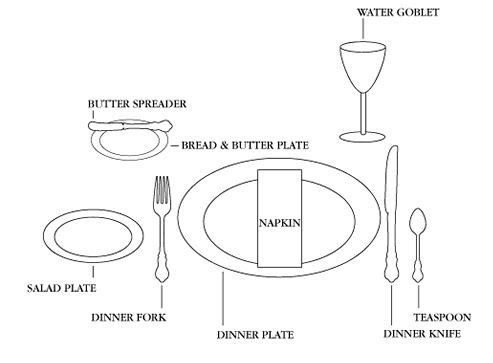
Dining Place Settings - Week 1: Basic Table Setting
Basic Table Setting
According to Emily Post:
For a basic table setting, here are two great tips to help you -- or your kids -- remember the order of plates and utensils:
Picture the word "FORKS." The order, left to right, is: F for Fork, O for the Plate (the shape!), K for Knives and S for Spoons. (Okay -- you have to forget the R, but you get the idea!)
Holding your hands in front of you, touch the tips of your thumbs to the tips of your forefingers to make a lowercase 'b' with your left hand and a lowercase 'd' with your right hand. This reminds you that "bread and butter" go to the left of the place setting and "drinks" go on the right. Emily Post could have used that trick -- she was often confused about which bread and butter belonged to her -- and sometimes she used her neighbor's! In which case, when it was called to her attention, she would say to the dismayed lady or gentleman, "Oh, I am always mixing them up. Here, please take mine!"
Some other things to know:
Knife blades always face the plate
The napkin goes to the left of the fork, or on the plate
The bread and butter knife are optional
References:
Wednesday, April 6, 2011
Etiquette in the Career Services Center
This month the Career Services Center (CSC) is hosting its Business Etiquette Dining Workshop. The orientation was held last night, and the participating students are eagerly awaiting the workshop, which will be held in the West Alabama Center for Workforce Development. As advertised, registration closed for the workshop on March 25th.
The word ETIQUETTE originated in France with Louis XIV’s reign. His gardener noticed that visitors to Versailles were walking through the gardens and destroying the beautiful landscaping at the palace. The gardener took it upon himself to make ‘etiquets’, or signs, to ward the aristocrats off the grass. The signs evolved into tickets issued to the visiting guests with more instructions on expectations from the King of Versailles. Some of these instructions included where each guest was expected to stand and what was to be done while visiting the palace.
Etiquette still holds the original meaning of “keep off the grass”. However, it has evolved into being the umbrella for protocol of proper manners.
Today there are hundreds of books and articles full of DOs and DON’Ts at the table and in public settings. It can become very confusing to one researching the rules, and oftentimes the information contradicts itself. The CSC has found it is much simpler if a student will research 2 or 3 top information guides and stick with only those few groups. Emily Post is the primary source of information used in the CSC. Ms. Post and her family’s empire have maintained the standards of etiquette since 1946 and is an excellent social barometer for all areas of etiquette.
The Business Etiquette orientation and workshop offer instruction regarding a business meal in the following areas:
• Preparation
• Communication
• Table manners
• Follow up
The students will attend 2 sessions. The first will discuss material leading up to the meal. They will learn about proper dress, researching the company, and arriving at the restaurant. The second portion of the workshop will provide instruction with informal place settings and formal place settings. The students will learn how to conduct themselves at the dinner table and how to use the proper etiquette involving each tool placed before them. Each student will have the opportunity to earn CEU’s by attending the workshop.
The word ETIQUETTE originated in France with Louis XIV’s reign. His gardener noticed that visitors to Versailles were walking through the gardens and destroying the beautiful landscaping at the palace. The gardener took it upon himself to make ‘etiquets’, or signs, to ward the aristocrats off the grass. The signs evolved into tickets issued to the visiting guests with more instructions on expectations from the King of Versailles. Some of these instructions included where each guest was expected to stand and what was to be done while visiting the palace.
Etiquette still holds the original meaning of “keep off the grass”. However, it has evolved into being the umbrella for protocol of proper manners.
Today there are hundreds of books and articles full of DOs and DON’Ts at the table and in public settings. It can become very confusing to one researching the rules, and oftentimes the information contradicts itself. The CSC has found it is much simpler if a student will research 2 or 3 top information guides and stick with only those few groups. Emily Post is the primary source of information used in the CSC. Ms. Post and her family’s empire have maintained the standards of etiquette since 1946 and is an excellent social barometer for all areas of etiquette.
The Business Etiquette orientation and workshop offer instruction regarding a business meal in the following areas:
• Preparation
• Communication
• Table manners
• Follow up
The students will attend 2 sessions. The first will discuss material leading up to the meal. They will learn about proper dress, researching the company, and arriving at the restaurant. The second portion of the workshop will provide instruction with informal place settings and formal place settings. The students will learn how to conduct themselves at the dinner table and how to use the proper etiquette involving each tool placed before them. Each student will have the opportunity to earn CEU’s by attending the workshop.
Wednesday, March 23, 2011
Business Etiquette Dining Workshop 2011
The Career Services Center will host its annual Business Etiquette Dining Workshop in April.
The workshop will be in the Workforce Development Center Conference Room. A meal will be served and instruction will be given on business dining etiquette at no cost to 15 currently enrolled Shelton State students.
Topics of discussion include the following:
- Dress
- At the table
- Placing orders
- Before the first course arrives
- Appetizers and soup
- The salad course
- The main course
- Dessert
- Coffee and tea
- General table manners
- The meal is over
- Tipping
- Thank you note
Students who wish to participate should contact the CSC by March 25th.
Email: bpatrick@sheltonstate.edu
Phone: 205.391.5874.
The workshop will be filled on a first come basis.
Thursday, March 17, 2011
Tips To Consider AFTER the Career Fair
- Send a thank you note to recruiters that spent time with you
- Keep a log of recruiters you met
- Keep a file of brochures received for later use
- Plan for improvement before next year’s career fair
The Career Services Centere would like send a special thank you to all who participated in this year's Fair! Thanks to you, it was a success!
The following is a list of participating vendors at the Career Fair, 2011:
AL Dept. of Rehab. Services
Alabama Credit Union
Bama Dining
Big Brothers Big Sisters of West Alabama
Birmingham Electrical NJATC
Buffalo Rock Company
Campus Way Apartments
Car Max
Charter Communications
Cintas Corporation
City of Northport
City of Tuscaloosa
City of Tuscaloosa Fire & Rescue Service Department
Comcast
David A. Scott, DMD
DCH Health System
Fountainbleau Management Services
Glen Haven Health & Rehabilitation, LLC
H&R Block
Hunt Refining Company
Indian Rivers Mental Health Center
Key Staff Source, Inc.
Maurices
McAbee Construction
Nancy Taylor Skin Therapy & Day Spa
PanAmerican Consultants, Inc
Parker Towing
Peco Foods, Incorporated
Plumbers and Pipe Fitters Local 372
PRIMERICA Financial Services
Quality Mazda
Ready To Work - Shelton State Community College
Regions Center
Robertson Banking Company
Sealy Management Co., Inc.
Seed The Clouds
Shelton State Community College Technical Services
Southland International Trucks
Tera Lane
The University of Alabama - Human Resources
The University of Alabama-College of Continuing Studies
The Westervelt Company
Thompson Tractor Co., Inc.
Transportation Security Administration/ Department of Homeland Security
Tuscaloosa Area Career Center
Tuscaloosa Med Center North/South
Tuscaloosa Police Department
U.S. Army
Wells Fargo
Wednesday, March 2, 2011
Career Fair - March 9, 2011!!
Shelton State Community College's annual Career Fair will be March 9, 2011. It will be held in the Martin Campus Atrium from 9 AM - 12 NOON.
Students should come prepared to speak to representatives from over 45 companies within the Tuscaloosa and surrounding areas. It is good practice for each student to bring several copies of his or her resume to hand to select companies.
We are excited to announce the Tuscaloosa Area Career Center will be on campus with its "Mobile Career Center". Students will have the opportunity to speak with representatives from the local office and to register with the JobLink website. JobLink is the state database for clients looking for employment and is used for jobseekers to post their resumes and apply for jobs. JobLink is also for employers to post jobs around Alabama and to review jobseekers' resumes.
A complete online list of companies planning to attend is as follows:
AL Dept. of Rehab. Services
Alabama Credit Union
Bama Dining
Big Brothers Big Sisters of West Alabama
Birmingham Electrical NJATC
Buffalo Rock Company
Campus Way Apartments
Charter Communications
Cintas Corporation
City of Northport
City of Tuscaloosa
City of Tuscaloosa Fire & Rescue Service Department
Comcast
David A. Scott, DMD
DCH Health System
Glen Haven Health & Rehabilitation, LLC
H & R Block
Home Builders Association
Hunt Refining Company
Indian Rivers Mental Health Center
Key Staff Source, Inc.
Maurices
McAbee Construction
Nancy Taylor Skin Therapy & Day Spa
PanAmerican Consultants, Inc
Parker Towing
Peco Foods, Incorporated
Plumbers and Pipe Fitters Local 372
PRIMERICA Financial Services
Ready To Work - Shelton State Community College
Regions Center
Robertson Banking Company
Salon Studios, Inc
Sealy Management Co., Inc.
Seed The Clouds
Shelton State Community College Technical Services
Southland International Trucks
The University of Alabama - Human Resources
The University of Alabama-College of Continuing Studies
The Westervelt Company
Thompson Tractor Co., Inc.
Transportation Security Administration/ Department of Homeland Security
Tuscaloosa Area Career Center
Tuscaloosa Med Center North/South
Tuscaloosa Police Department
U.S. Army
Quality Mazda and Volkswagon
Wells Fargo
Students should come prepared to speak to representatives from over 45 companies within the Tuscaloosa and surrounding areas. It is good practice for each student to bring several copies of his or her resume to hand to select companies.
We are excited to announce the Tuscaloosa Area Career Center will be on campus with its "Mobile Career Center". Students will have the opportunity to speak with representatives from the local office and to register with the JobLink website. JobLink is the state database for clients looking for employment and is used for jobseekers to post their resumes and apply for jobs. JobLink is also for employers to post jobs around Alabama and to review jobseekers' resumes.
A complete online list of companies planning to attend is as follows:
AL Dept. of Rehab. Services
Alabama Credit Union
Bama Dining
Big Brothers Big Sisters of West Alabama
Birmingham Electrical NJATC
Buffalo Rock Company
Campus Way Apartments
Charter Communications
Cintas Corporation
City of Northport
City of Tuscaloosa
City of Tuscaloosa Fire & Rescue Service Department
Comcast
David A. Scott, DMD
DCH Health System
Glen Haven Health & Rehabilitation, LLC
H & R Block
Home Builders Association
Hunt Refining Company
Indian Rivers Mental Health Center
Key Staff Source, Inc.
Maurices
McAbee Construction
Nancy Taylor Skin Therapy & Day Spa
PanAmerican Consultants, Inc
Parker Towing
Peco Foods, Incorporated
Plumbers and Pipe Fitters Local 372
PRIMERICA Financial Services
Ready To Work - Shelton State Community College
Regions Center
Robertson Banking Company
Salon Studios, Inc
Sealy Management Co., Inc.
Seed The Clouds
Shelton State Community College Technical Services
Southland International Trucks
The University of Alabama - Human Resources
The University of Alabama-College of Continuing Studies
The Westervelt Company
Thompson Tractor Co., Inc.
Transportation Security Administration/ Department of Homeland Security
Tuscaloosa Area Career Center
Tuscaloosa Med Center North/South
Tuscaloosa Police Department
U.S. Army
Quality Mazda and Volkswagon
Wells Fargo
Wednesday, February 23, 2011
Wednesday, February 16, 2011
Tips to consider BEFORE the Career Fair
• Research the companies that will be attending
• Check the SSCC web page to see a current list of registered companies
• Identify your purpose for attending
• Identify your career interests
• Identify your career focus
• Prepare a resume
• Practice mock interviews
• Check your dress
• Create a personal sound bite and commercial/elevator speech
(Click HERE to create your own commercial/elevator speech)
Wednesday, February 9, 2011
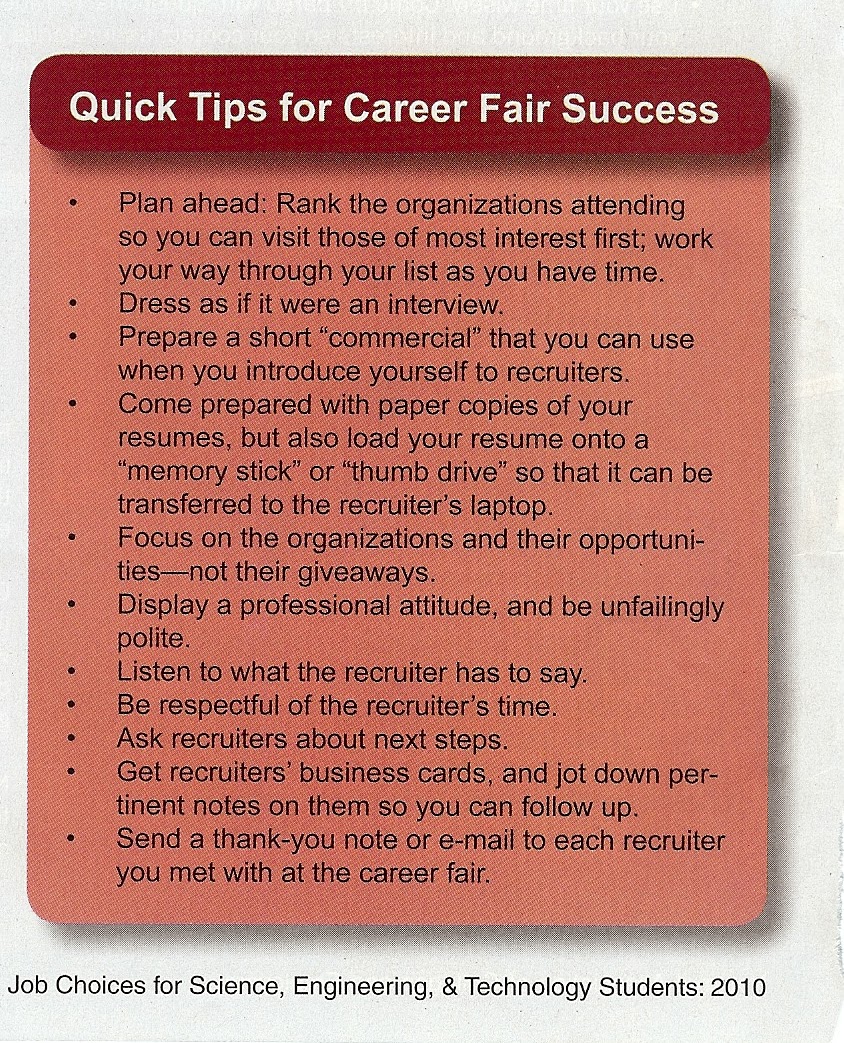
Tips To Consider AT The Career Fair
CAREER FAIR, WEDNESDAY, MARCH 9, 2011!
Tips to consider AT the Fair
- Arrive as early as possible
- Dress appropriately
- Smile
- Use a firm handshake
- Maintain eye contact
- Be organized
- Keep resumes in a folder
- Keep a notebook to job information obtained
- Keep business cards in a folder
- Deliver your sound bite or commercial before asking questions of the company
- Ask questions that have been thought out beforehand
- Do not ask questions about salary
- Gather free information and business cards after speaking with the recruiter
- Feel free to pick up free items but do not act like you are at a “blue light” special
- Ask the best way to follow up if you are interested in doing so
Friday, February 4, 2011
Shelton State Career Fair 2011 - March 9, 2011
What is the purpose of the SSCC Career Fair?
- Learn about local community businesses' services and products
- Learn about local job/career opportunities
- Make an on sight connection between training and employment
- Learn about co-ops and internships offered between SSCC and local businesses
- Make contacts for employment
- Begin to put into practice job search skills
Wednesday, January 26, 2011
What Are You Planning To Do To Create Your Own Sputnik Moment?
Riding on the heels of President Obama’s speech to our country last night, the Career Services Center wants to encourage YOU to aim high and set a competitive tone for your career goals. Regardless if any of us approve or disapprove with the President’s words, we all should not settle for mediocrity; instead, we should set personal goals for ourselves that will not only improve our own lives, but also improve the livelihood of those around us.
Our country was not founded on the belief the world would come to us if we just sat and waited. Instead, our founding fathers and millions of people after them have strived to set out to create their own destiny. They have worked endlessly at accomplishing their goals through the basic values of hard work and determination.
If you are one of the few who start college with a predetermined career goal, it is up to you to research the field of study you are in, track trends within the field, and explore your options. If you do not know what career you wish to choose, it is your responsibility to do the research of the ever-growing list of careers available.
The Career Services Center is established to help you locate the resources needed to allow you to plan, explore, prepare, and succeed. Click HERE to visit our website with helpful tips on the four topics. Stop by the Center for any questions or career needs.
We hope you will make this semester a successful one and look forward to seeing great things from all of you in the future.
Our country was not founded on the belief the world would come to us if we just sat and waited. Instead, our founding fathers and millions of people after them have strived to set out to create their own destiny. They have worked endlessly at accomplishing their goals through the basic values of hard work and determination.
If you are one of the few who start college with a predetermined career goal, it is up to you to research the field of study you are in, track trends within the field, and explore your options. If you do not know what career you wish to choose, it is your responsibility to do the research of the ever-growing list of careers available.
The Career Services Center is established to help you locate the resources needed to allow you to plan, explore, prepare, and succeed. Click HERE to visit our website with helpful tips on the four topics. Stop by the Center for any questions or career needs.
We hope you will make this semester a successful one and look forward to seeing great things from all of you in the future.
Thursday, January 20, 2011
Students! Start Your Engines!
The Shelton State Career Services Center hopes you had a restful and happy holiday! We also hope you are ready to begin your classes this semester with a rested mind and fresh outlook on your studies.
We would like to encourage you to view our "Planning Your Career Path" in order to make sure you are going in the right direction.
Click HERE to view the "Planning Your Career Path" form.
The following article was found at About.com and offers three helpful tips to make sure you start the semester right.
How To Start The Semester Right
By Tara Kuther, Ph.D., About.com Guide
The most effective way to ensure success in classes -- learning and getting good grades -- is to prepare early and often. Most students recognize the value of preparation in ensuring excellent class performance. Prepare for each class, each test, each assignment. Preparation, however, begins before the first reading assignment and first class. Prepare for the semester and you'll be off to a great start. So, how do you start the semester right? Get into the proper mindset by following these three tips.
Plan to work.
Colleges - and faculty - expect you to put in a significant amount of time over the course of the semester. At the undergraduate level, a 3 credit course generally meets for 45 hours during the semester. In most cases you are expected to put in 1 to 3 hours for every hour of class time. So, for a class that meets 2.5 hours a week, that means you should plan to spend 2.5 to 7.5 hours outside of class preparing for class and studying the material each week. You likely won't spend the maximum time on every class every week - it's a big time commitment! But recognize that some classes will require relatively little prep and others may require additional hours of work. In addition, the amount of time you spend on each class will vary over the semester.
Get a head start.
This one is simple: Begin early. Read ahead. Try to stay one reading assignment ahead of class. First, this permits you to see the big picture. Readings tend to build on each other and sometimes you may not realize that you don't understand a particular concept until you encounter a more advanced concept. Second, reading ahead gives you wiggle room. Life sometimes gets in the way and we fall behind in reading. Reading ahead permits you to miss a day and still be prepared for class. Likewise, start papers early. Papers nearly always take longer to write than we anticipate, whether it's because we can't find sources, have a hard time understanding them, or suffer from writer's block. Start early so that you won't feel pressed for time.
Mentally Prepare.
Get your head in the right place. The first day and week of classes can be overwhelming with new lists of reading assignments, papers, exams, and presentations. Take the time to map out your semester. Write down all classes, due dates, exam dates. Think about how you will organize your time to prepare and get it all done. Plan time off and time for fun. Think about how you will maintain motivation over the semester - how will you reward your successes? By mentally preparing for the semester ahead you put yourself in the position to excel.
References: http://gradschool.about.com/od/survivinggraduateschool/a/startsemester.htm
Wednesday, December 8, 2010
Calling All Job Seekers!
The Career Services Center (CSC) at Shelton State Commuinty is dedicated to providing career seeking assistance to current and former students. Although the CSC does not participate in job placement, we do offer advice on where to look for the most current job postings along with strengthening your job seeking skills. (examples: resumes, cover letters, interview skills, etc)
The CSC posts all job postings sent to our office on the 'Career Services Center' website located at SheltonState.edu under the 'Workforce Opportunities' tab.
Click HERE to go straight to the Job Postings site.
Also, we offer a list of websites that focus on jobs available.
Click HERE to go straight to the Job Search site.
Please call or email us if you have any questions regarding searching jobs available.
Career Services Center
205.391.5874
bpatrick@sheltonstate.edu
Tuesday, November 23, 2010
Let's Talk Turkey
In the spirit of Thanksgiving, the Career Services Center would like to let YOU know how thankful we are to serve YOU. We have the privilege to work with some of the most talented, intelligent, and gifted students around.
I can’t find the right words to express how much I adore the following article. I hope you will take time to read each word and marinate on the thought of YOUR uniqueness.

Career Coach: Be Thankful for Your Uniqueness
By: Pamela Kleibrink Thompson.
During the filming of Some Like it Hot, Tony Curtis (who just recently passed away) pointed out to director Billy Wilder that he was doing an impression of Cary Grant. Billy Wilder replied, "If I wanted Cary Grant, I would have hired Cary Grant."
There is no one else in the world exactly like you. You have talents, experiences and a perspective that make you unique. Be grateful for your unique gifts. Nurture and develop them and utilize your strengths to add your unique vision and insights to the world. Your uniqueness is your most marketable quality. Yet many creative people make the mistake of chasing the latest fad or imitating the newest style.
It's tempting to chase trends or emulate successful people. I fell into this trap. Years ago I worked on a screenplay with a friend of mine I knew since high school. We were 3/4 of the way done with our script and we decided to celebrate and went to the movies. We were enthralled with the escapades of Indiana Jones in the Raiders of the Lost Ark. We decided to rewrite our detective screenplay in the Indiana Jones style. We never finished it.
"I don't know the key to success, but the key to failure is trying to please everybody." -- Bill Cosby
Don't try to chase the market or try to please everyone. Imagine Leonardo da Vinci painting the Mona Lisa in a storefront window. People pass by giving him feedback on his work in progress. "I think her dress should be a lighter color." "Her smile should be bigger." "The painting should be bigger." "She should wear her hair up." "The background should be the city, not the mountains." "There is too much shadow under her chin." Can you imagine Leonardo changing the painting as people made comments, concerned about whether everyone would like La Gioconda when it was finished?
Those who allow their unique strengths to set them apart from the crowd are those who achieve milestones in science, art and literature.
Whenever you are tempted to blend in and try to be popular with everyone, remind yourself of your uniqueness -- your passion and goals. Dare to be different and you will achieve success. Again, you can't be all things to all people. Rita Mae Brown reminds us: "The reward for conformity is that everyone likes you except yourself."
Be thankful that you are different from everyone else in the world. You have a unique contribution to make. Go ahead. Be distinctive. Originals are rare.
Pamela Kleibrink Thompson is grateful for her family and the opportunity to contribute the Career Coach column to AWN and for all the readers and followers. She is a recruiter, career coach and speaker. You can contact her at PamRecruit@q.com.
Pamela Kleibrink Thompson dares you to be yourself.
By Pamela Kleibrink Thompson
Monday, November 1, 2010 at 3:41 pm
Posted In
Columns: Career
Site Categories: Education and Training, Jobs & Recruiting
Reference: http://www.awn.com/articles/advice/career-coach-be-thankful-your-uniqueness
Photo: http://www.clipartof.com/
I can’t find the right words to express how much I adore the following article. I hope you will take time to read each word and marinate on the thought of YOUR uniqueness.
Career Coach: Be Thankful for Your Uniqueness
By: Pamela Kleibrink Thompson.
During the filming of Some Like it Hot, Tony Curtis (who just recently passed away) pointed out to director Billy Wilder that he was doing an impression of Cary Grant. Billy Wilder replied, "If I wanted Cary Grant, I would have hired Cary Grant."
There is no one else in the world exactly like you. You have talents, experiences and a perspective that make you unique. Be grateful for your unique gifts. Nurture and develop them and utilize your strengths to add your unique vision and insights to the world. Your uniqueness is your most marketable quality. Yet many creative people make the mistake of chasing the latest fad or imitating the newest style.
It's tempting to chase trends or emulate successful people. I fell into this trap. Years ago I worked on a screenplay with a friend of mine I knew since high school. We were 3/4 of the way done with our script and we decided to celebrate and went to the movies. We were enthralled with the escapades of Indiana Jones in the Raiders of the Lost Ark. We decided to rewrite our detective screenplay in the Indiana Jones style. We never finished it.
"I don't know the key to success, but the key to failure is trying to please everybody." -- Bill Cosby
Don't try to chase the market or try to please everyone. Imagine Leonardo da Vinci painting the Mona Lisa in a storefront window. People pass by giving him feedback on his work in progress. "I think her dress should be a lighter color." "Her smile should be bigger." "The painting should be bigger." "She should wear her hair up." "The background should be the city, not the mountains." "There is too much shadow under her chin." Can you imagine Leonardo changing the painting as people made comments, concerned about whether everyone would like La Gioconda when it was finished?
Those who allow their unique strengths to set them apart from the crowd are those who achieve milestones in science, art and literature.
Whenever you are tempted to blend in and try to be popular with everyone, remind yourself of your uniqueness -- your passion and goals. Dare to be different and you will achieve success. Again, you can't be all things to all people. Rita Mae Brown reminds us: "The reward for conformity is that everyone likes you except yourself."
Be thankful that you are different from everyone else in the world. You have a unique contribution to make. Go ahead. Be distinctive. Originals are rare.
Pamela Kleibrink Thompson is grateful for her family and the opportunity to contribute the Career Coach column to AWN and for all the readers and followers. She is a recruiter, career coach and speaker. You can contact her at PamRecruit@q.com.
Pamela Kleibrink Thompson dares you to be yourself.
By Pamela Kleibrink Thompson
Monday, November 1, 2010 at 3:41 pm
Posted In
Columns: Career
Site Categories: Education and Training, Jobs & Recruiting
Reference: http://www.awn.com/articles/advice/career-coach-be-thankful-your-uniqueness
Photo: http://www.clipartof.com/
Wednesday, November 17, 2010
Two Years to Graduation or Transfer
November is National Career Month!
This month Career Services is celebrating YOUR career dreams through National Career Month. The following is an overview of topics we feel are most important for you to prepare yourself to enter the work force. The article was found at http://www.jobweb.com/.
Two Years to Graduation or Transfer
You're planning to graduate with an associate's degree and find your spot in the work force—or you want to transfer to a four-year college at the end of two years. There are things you should do each semester to make it easier to reach your goals.
Here's a timeline to guide your progress:
Things everyone should do at the beginning of each semester:
• Make an appointment with a career services advisor to review your status in the career development process.
• Find the career center's webpage for career development and check out upcoming events.
• Update your resume. Have it critiqued and proofread by someone in the career services office.
• Check your career center's web site for an online job board or see if your career center keeps a notebook of job opportunities.
• Subscribe to and read professional journals in your field(s) of interest.
• Join the student version of professional associations and become an active member. This will help you build a network of colleagues in your field and give you valuable contacts for summer jobs, clinical rotations, and full-time jobs.
Year one: Ask questions. Explore. Research. Test your interests.
• Locate the career center on your campus as early as possible in your first year. You can find its location by going to your school's web site or by asking your adviser.
• Call the career center and make an appointment to talk to an advisor. If you've decided on a direction, the advisor can help you map out a strategy for reaching your goal. If you're undecided about what to major in or where you might want to be in two years, you can take assessment tests, including interest and career inventory tests to give you a direction to explore.
• Are you enjoying a specific class and think it might be the right field for you? Talk to faculty and professors about possible careers.
• Join at least one professional or honorary organization in your program of study to begin to build a valuable network. Even if you plan to transfer to a four-year college to continue your education, it's never too early to start building professional bridges.
• Scan Job Choices magazines (available in the Shelton State’s Career Center), the Occupational Outlook Handbook, and computer or web-based resources for clues to a future career. Your career center probably has an extensive library of career-search books, software, and web sites to explore.
• Attend on- and off-campus career and job fairs to get a look at potential careers and employers in fields that interest you.
• Find a part-time or summer job in your field of interest.
• If you're planning to transfer to a four-year school, research schools that specialize in your program of study. The career services office often has information on potential places to go.
Year Two: Time for your job search or to transfer to a university.
If you're planning a job search:
• Update your resume and take it to a career services advisor to have it critiqued.
• Ask your career center for a checklist of specific activities to follow to organize your job search. This will ensure you don't miss essential steps in the job-search process, or resources to help you locate employment options.
• Check your career center's web site information about mock interviews.
• When preparing for your interviews, pay particular attention to the top skills employers seek and the top skills candidates lack.
• Take leadership positions in student chapters of professional associations.
• Draft a cover letter that you can adapt for a variety of employers and get your letter critiqued.
• Follow-up on all job applications and keep a record of the status of each.
• Build a professional wardrobe.
• Make sure you research salary scales for your occupation, to include the geographic region where the job is located. Ask your career center for resources and assistance.
• Evaluate job offers and accept one. Ask your career center for help with job offer assessment and salary negotiation techniques.
• Report job offers and your acceptance to the career services office.
If you're planning to transfer:
• Update your resume and take it to a career services advisor to have it critiqued. You'll need an updated resume to find next summer's job in your field—and you'll need it when you check in with the career center at your transfer school.
o Attend on- and off-campus career and job fairs to get a look at potential careers and employers in fields that interest you.
o Find a part-time or summer job in your field of interest.
o Read at least one book on career planning recommended by career services staff.
o Explore at least three career options available to you through your program of study.
o Research various occupations in Job Choices and the Occupational Outlook Handbook and computer or web-based resources for clues to a future career.
o Identify organizations and associations in your interest areas for shadowing opportunities and informational interviews.
o Join at least one professional or honorary organization related to your program of study in order to contact with people in the professional world.
o Work toward one leadership position in a student/professional club or association.
o Begin to collect recommendations from previous and current employers.
o Put together an interview outfit.
o Complete applications for transfer to a four-year college or university.
o Find the career services office on your new campus.
Reference: http://www.jobweb.org/studentarticles.aspx?id=706
This month Career Services is celebrating YOUR career dreams through National Career Month. The following is an overview of topics we feel are most important for you to prepare yourself to enter the work force. The article was found at http://www.jobweb.com/.
Two Years to Graduation or Transfer
You're planning to graduate with an associate's degree and find your spot in the work force—or you want to transfer to a four-year college at the end of two years. There are things you should do each semester to make it easier to reach your goals.
Here's a timeline to guide your progress:
Things everyone should do at the beginning of each semester:
• Make an appointment with a career services advisor to review your status in the career development process.
• Find the career center's webpage for career development and check out upcoming events.
• Update your resume. Have it critiqued and proofread by someone in the career services office.
• Check your career center's web site for an online job board or see if your career center keeps a notebook of job opportunities.
• Subscribe to and read professional journals in your field(s) of interest.
• Join the student version of professional associations and become an active member. This will help you build a network of colleagues in your field and give you valuable contacts for summer jobs, clinical rotations, and full-time jobs.
Year one: Ask questions. Explore. Research. Test your interests.
• Locate the career center on your campus as early as possible in your first year. You can find its location by going to your school's web site or by asking your adviser.
• Call the career center and make an appointment to talk to an advisor. If you've decided on a direction, the advisor can help you map out a strategy for reaching your goal. If you're undecided about what to major in or where you might want to be in two years, you can take assessment tests, including interest and career inventory tests to give you a direction to explore.
• Are you enjoying a specific class and think it might be the right field for you? Talk to faculty and professors about possible careers.
• Join at least one professional or honorary organization in your program of study to begin to build a valuable network. Even if you plan to transfer to a four-year college to continue your education, it's never too early to start building professional bridges.
• Scan Job Choices magazines (available in the Shelton State’s Career Center), the Occupational Outlook Handbook, and computer or web-based resources for clues to a future career. Your career center probably has an extensive library of career-search books, software, and web sites to explore.
• Attend on- and off-campus career and job fairs to get a look at potential careers and employers in fields that interest you.
• Find a part-time or summer job in your field of interest.
• If you're planning to transfer to a four-year school, research schools that specialize in your program of study. The career services office often has information on potential places to go.
Year Two: Time for your job search or to transfer to a university.
If you're planning a job search:
• Update your resume and take it to a career services advisor to have it critiqued.
• Ask your career center for a checklist of specific activities to follow to organize your job search. This will ensure you don't miss essential steps in the job-search process, or resources to help you locate employment options.
• Check your career center's web site information about mock interviews.
• When preparing for your interviews, pay particular attention to the top skills employers seek and the top skills candidates lack.
• Take leadership positions in student chapters of professional associations.
• Draft a cover letter that you can adapt for a variety of employers and get your letter critiqued.
• Follow-up on all job applications and keep a record of the status of each.
• Build a professional wardrobe.
• Make sure you research salary scales for your occupation, to include the geographic region where the job is located. Ask your career center for resources and assistance.
• Evaluate job offers and accept one. Ask your career center for help with job offer assessment and salary negotiation techniques.
• Report job offers and your acceptance to the career services office.
If you're planning to transfer:
• Update your resume and take it to a career services advisor to have it critiqued. You'll need an updated resume to find next summer's job in your field—and you'll need it when you check in with the career center at your transfer school.
o Attend on- and off-campus career and job fairs to get a look at potential careers and employers in fields that interest you.
o Find a part-time or summer job in your field of interest.
o Read at least one book on career planning recommended by career services staff.
o Explore at least three career options available to you through your program of study.
o Research various occupations in Job Choices and the Occupational Outlook Handbook and computer or web-based resources for clues to a future career.
o Identify organizations and associations in your interest areas for shadowing opportunities and informational interviews.
o Join at least one professional or honorary organization related to your program of study in order to contact with people in the professional world.
o Work toward one leadership position in a student/professional club or association.
o Begin to collect recommendations from previous and current employers.
o Put together an interview outfit.
o Complete applications for transfer to a four-year college or university.
o Find the career services office on your new campus.
Reference: http://www.jobweb.org/studentarticles.aspx?id=706
Wednesday, November 10, 2010
November is National Career Development Month!
This month we are celebrating YOUR career dreams. 2010 marks the 45th anniversary for National Career Month. If you have not already started to think about your career, The Career Services Center at Shelton State invites you to visit us in the West Alabama Center for Workforce Development or online by clicking HERE. You can also check out our window case located on the 2nd floor next to the Faculty Resource Center/ Faculty office entrance for current information.
In addition to a quality education, Shelton State Community College offers result-oriented career assistance through the Career Services Center. The Shelton State Career Services Center serves as a liaison for current students, alumni, and West Alabama businesses and industry. The Career Services Center welcomes the opportunity to provide services and make a difference in the lives of currently enrolled students and alumni by providing employers with qualified potential employees. Examples of services include: wage information for cities across the country, industry trends, internship information, employer profiles, resume proofreading, on-campus mock interviews, current full and part-time job-openings, and career workshops hosted by local business and industry.
The Career Services Center is dedicated to serving the needs of the community as well as the graduating students and alumni. The Center welcomes the opportunity to make a difference in the lives of students and assist business/industry with qualified employees.
In addition to a quality education, Shelton State Community College offers result-oriented career assistance through the Career Services Center. The Shelton State Career Services Center serves as a liaison for current students, alumni, and West Alabama businesses and industry. The Career Services Center welcomes the opportunity to provide services and make a difference in the lives of currently enrolled students and alumni by providing employers with qualified potential employees. Examples of services include: wage information for cities across the country, industry trends, internship information, employer profiles, resume proofreading, on-campus mock interviews, current full and part-time job-openings, and career workshops hosted by local business and industry.
The Career Services Center is dedicated to serving the needs of the community as well as the graduating students and alumni. The Center welcomes the opportunity to make a difference in the lives of students and assist business/industry with qualified employees.
Thursday, November 4, 2010
Politics. Smolitics.
All of the political talk this week has got us thinking in Career Services. How many of you actually went to the polls on Tuesday to vote?? As a U.S. citizen, you are privileged to have this opportunity to make your voice heard. Approximately 99% of college students are eligible to vote, if just age is taken into account. However, according to surveys, only about 25.5% of the student body is likely to vote.
Although it is too late for this past election, it is never too early to begin readying yourself to vote in the future. Two years from now, you will have another opportunity to raise your hand and speak out. With the Presidential election comes great responsibility. You will have a chance to stand with fellow American citizens to let the government know how you think your tax dollars should be spent – or who should be in control of the educational system to which you are a part of. It is a duty and privilege to have this opportunity. We hope you will embrace it with a mature attitude by educating yourself starting now so you will be able to make the best choice.
The following are a few tips to help you get started:
1. Know where you are eligible to vote. If you are a resident of Tuscaloosa Co. (meaning, do you pay a utility bill?) you have the right to vote in Tuscaloosa. If you live in a dorm, you are probably still registered in your hometown. You will be able to vote by absentee ballot.
More information on registering to vote can be found by visiting this site: http://www.declareyourself.com/
2. Study the candidates. By tracking the potential candidates now, you will build a foundation of knowledge on each issue and where each candidate stands. This will save you time in the future and allow you to speak intellectually with your friends. You also will have a better understanding of who you want to vote for come Election Day.
Click on the following link to read the Wikipedia’s view of the 2012 Election: http://en.wikipedia.org/wiki/United_States_presidential_election,_2012
3. Talk amongst your friends. It is a good idea to engage in friendly conversations regarding the elections, candidates, and views of others. Be careful, however, to not confuse yourself by speaking to too many people. This could swing your vote in a different direction without merit or deter you from voting at all.
4. Make a List. Think about what you hold valuable. Make a list of the views and topics you feel you should base your vote on. 1st – write out the topics with your opinion that you know you absolutely do not want to compromise. (Example: are you Pro-Life? Pro-Choice? Etc) 2nd – list the topics you are concerned about but don’t have a strong opinion one way or another. Then research each candidate and rate them according to the topics you listed. This will help you narrow down your selection and allow you to make a smart choice.
Regardless if you voted this past Tuesday or intend to vote on Election Day 2012, know you have a responsibility to be informed.
References:
1. http://letuyellowjacket.org/?p=94
2. CIRCLE (The Center for Information and Research on Civic Learning and Engagement)
3. Photo: - www.campussolutionsinc.com
Subscribe to:
Posts (Atom)